

Life on (Nonsuch) Earth
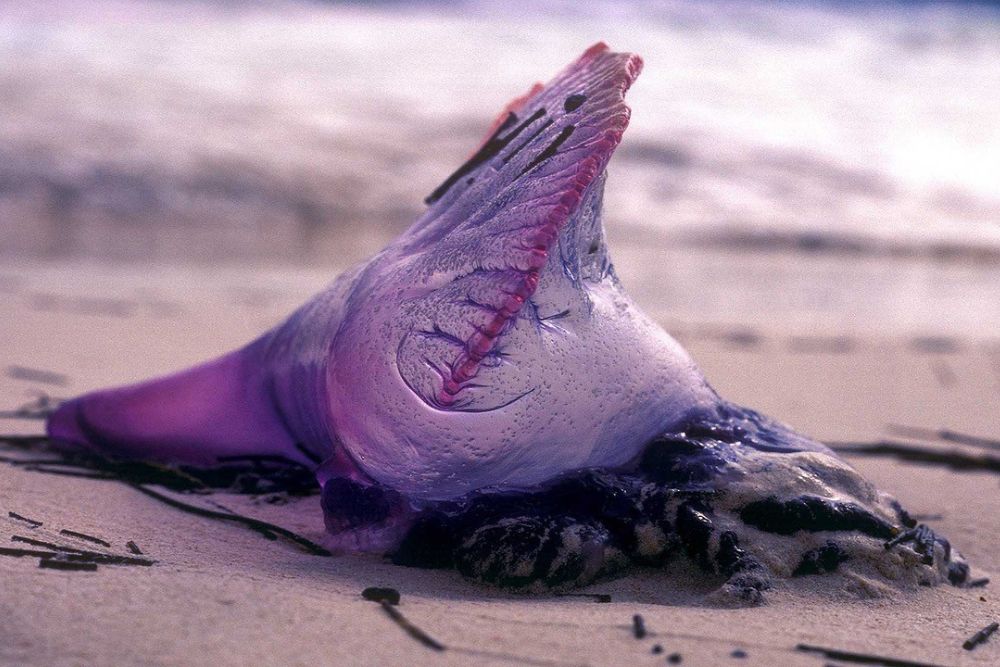
❬ BACK TO STORIES Instagram Twitter Facebook Youtube LIFE ON (NONSUCH) EARTH PETER PARKS One very grey stormy evening on Nonsuch Island, off the coast of Bermuda (on that same island as William Beebe lived while doing his epic deep-sea descent in the bathysphere, built by his engineering colleague, Otis Barton), I witnessed one of the most remarkable things I have ever seen. I strolled down to South Beach – sounds grand, but it is only about 120 feet long – and stood looking out to sea, watching the wind whip the tops off the incoming waves, while following the vain progress of numerous men-o-war, trying not to get themselves stranded on the beach. Men-o-war have no guard against this disaster other than to withdraw tentacles, deflate their floats and reduce their surface area to wind and wave. One-by-one they succumbed – slewed up the sloping sand, like inky smudges emanating from stranded bottles. One beached itself close to where I was standing, but from somewhere, came a curious slapping sound. Men-o-war do not have the ability to so much as twitch, let alone slap. I was sure that my ears were not playing tricks. Once again it happened, and this time the sound definitely came from exactly where a man-o-war lay, just as the water receded from around it, leaving it high and dry. I began then to watch men-o-war more closely, as they approached the shore. One came in, became stranded, and was accompanied by no sound at all. Another came towards me, and suddenly I knew what it was. This one had, beneath its tentacles, a very agitated Nomeid Man- o-war Fish – its startling silver and navy blue stripes unquestionably identifying it. As the Physalia swirled in on the next wave, the nomeid came with it. Now the pair were in only two inches of water and this was rapidly dwindling to two millimetres. Both creatures bottomed on the streaming wet sand. The Physalia lay limp and defeated, but not its faithful friend. The man-o-war fish fought furiously to swim, but no water! Suddenly its swimming activity translated into that mechanical rattling. It slapped the sand with its tail, making a sound like a football rattle. For fully twenty seconds it struggled. On the next but one wave it was afforded just enough depth of water, and it reluctantly allowed itself to be floated seawards, yet still faced back up the beach towards its now dying companion. What friendship, what faith, what pathos. ❬ BACK TO STORIES Instagram Twitter Facebook Youtube From Tiny Egg to Underwater Chameleon… Read More Floating, Stinging and Beautiful Bubbles… Read More
3 Sailed Triangle or a Shovel Nose Ray?
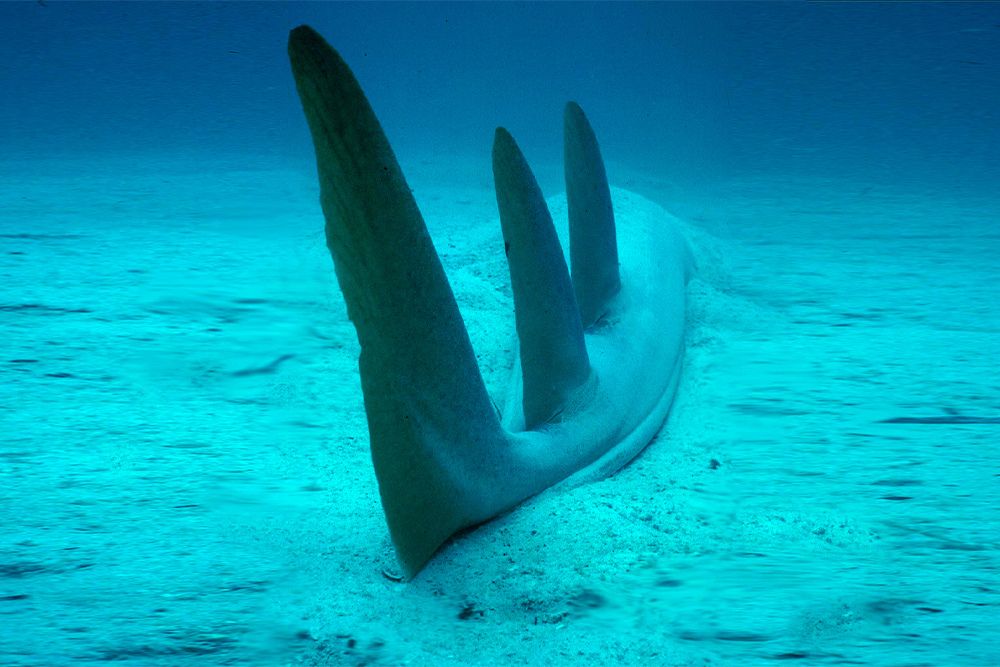
❬ BACK TO STORIES Instagram Twitter Facebook Youtube 3 Sailed Triangle or a Shovel Nose Ray? PETER PARKS “I felt something touch my arm. My partner beckoned me to follow him and not waste time. We swam in silent tandem back towards the bay where our boat was moored. As we rounded the spur of mangrove, my partner indicated particular stealth and then held his arms wide, indicating large size. Oh yes, another big sting ray that would disappear into oblivion before we got anywhere near. My partner noticed my scepticism and broke surface, removing his demand valve sufficient to gurgle “Shovel-Nose Shark – huge!” Uh-uh, I thought all of a metre long. Into the gloom we returned and my guide then slowed, stopped and pointed. I peered. Solid gloom. Something vaguely sticking out of the sand – no, two things – no, …… three, all identical. I crept forward on finger tips. What were these three things and why side by side? My eyes accustomed to the low contrast scene. I looked left and right. Suddenly it dawned on me. The three things were all part of the same, and all were in line – occupying only the hind quarter of what I could now see was an enormous flattened body. My partner was absolutely right. This beast was indeed huge. I estimated it to be ten foot long and to weigh well over half a ton. This was a serious fish. The three vertical ‘sails’ were the tail fin, the adipose fin and the dorsal fin – all almost identical and each standing three quarters of a metre off the floor of the lagoon. The next question was how to do justice to it photographically. I decided, stills first, movie second. The Nikonos around my neck had a new roll of film in it and a 24 mm lens. To make this creature look the size it was, I was going to have to get very close. Very, very close. At this stage, I was broadside on. On the basis that being hit by half a ton of pointed ray was less to my liking than being flicked in the face by its tail, I decided to try the approach from the rear. Finger power eased me forward at a snail’s pace. Now my heart was thumping, not because of fright, just because I so wanted a decent shot. Closer and closer I crept, until the caudal fin loomed large in the viewfinder. I began to click away, scared that the percussive note would frighten her away. (The sex of the beast was female, I believe, since I could see no signs of claspers). The ray remained motionless. Click, creep, click, creep. I could now reach forward and easily touch the caudal fin. This was the shot, with those three sails, en-echelon. I backed away and began a laborious circumnavigation on a fifteen metre diameter arc, to get ahead of the ray. Now I had real reason to be apprehensive. From the front, this shovel nose looked extremely mean, and with those fins at the back end, she sure wouldn’t hang around when she decided to go. Now I was six foot from the snout. Click. Now five feet. Click. Four feet. Click. My nerve ran out. I eased off, reminding myself I still wanted a movie sequence, and a head on my shoulders! I sidled back to the boat, exchanged cameras and re-approached madam, from the side and a little behind. This time I wanted movement, but the roll of film had only twelve seconds of film to run… I crept towards the three sails. A lateral establishing shot first. Got it. Six or seven seconds left. Closer. Just before I settled for the shot – the intention movement of imminent departure – the operculum rose an inch or so. Sure enough, she was off and away in her own ‘smoke’ screen of sand. I shot it, but I would have so liked to be closer and to have had more film. Nonetheless, a memorable encounter and, like all fishy tales, my partner’s arms held wide had been out by a factor of two, but downwards, not upwards on this occasion!” ❬ BACK TO STORIES Instagram Twitter Facebook Youtube From Tiny Egg to Underwater Chameleon… Read More Floating, Stinging and Beautiful Bubbles… Read More
A Titan Prank and Spear Gun Mishap…
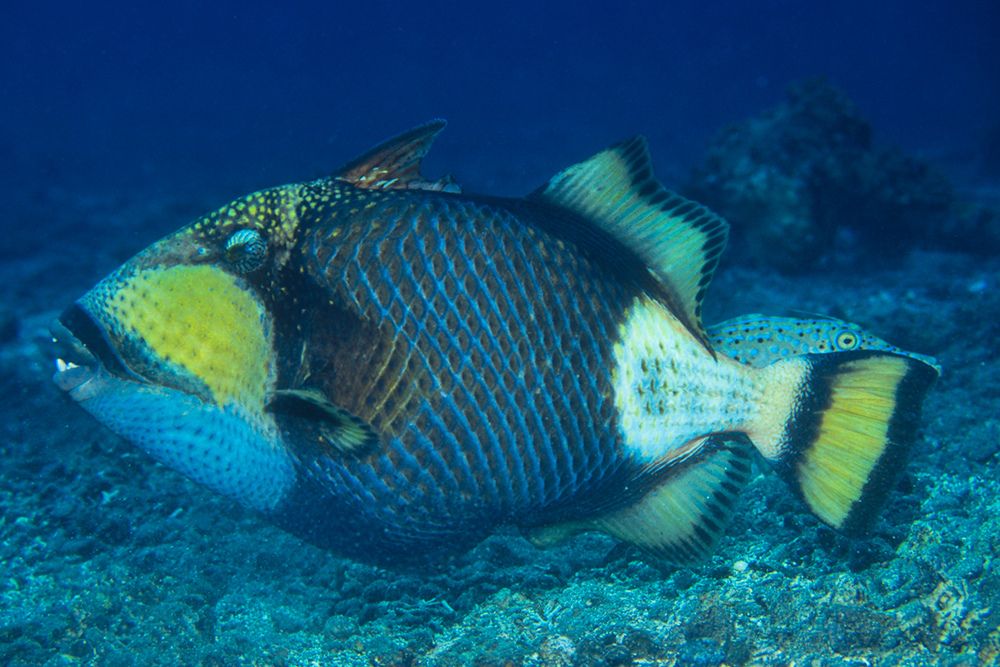
❬ BACK TO STORIES Instagram Twitter Facebook Youtube A TITAN PRANK AND SPEAR GUN MISHAP GERRY ALLEN “Jack had a wonderful sense of humour and was a good sport when he was on the receiving end of practical jokes. There are so many great stories from my travels with Jack and here are just a few examples. My good friend Roger Steene and I joined Jack for a lengthy sojourn across the Indian Ocean that was funded by the National Geographic Society in 1979. Knowing Jack’s passion to log more dives than anyone on the planet Roger and I set up a little practical joke while we were at Villingili Resort in the Maldives. The previous night we fetched a couple of scuba tanks from the dive shop and rigged them up with our gear before retiring. Then we set the alarm for 5 AM. The next morning, while it was still dark we hopped out of bed, donned the scuba tanks and took turns spraying each other with a garden hose. It looked like we had just emerged from a dive. Time to put the plan into action! We tip-toed over to Jack’s bungalow, deliberately clanked the tanks together several times and started loudly exclaiming what a great dive we had. Predictably, Jack rose to the bait. He bolted out of bed, grabbed his gear and virtually ran over to the dive shop to grab a tank. No way was he going to be out-dived, even if it meant diving at 5 in the morning. I think he finished the day with 6 or 7 dives, which was a typical effort. Absolutely nothing distracted Jack once he locked onto a potential fish specimen or photographic subject. With this knowledge Roger and I set a little trap for Jack while on the same visit to the Maldives. Female Titan Triggerfish (Balistoides viridescens) are notoriously aggressive when guarding a nest of eggs. We had both been molested by a particularly savage individual while taking underwater photographs the previous day. At one point I fended an attack by thrusting my camera towards the trigger. The fish actually seized the strobe-mounting bar with its teeth and swam off with the entire camera rig. This was one ferocious fish! It seems fiendish in retrospect, but somehow seemed entirely appropriate at the time… We hatched a plan whereby we would return to the same spot and line the triggerfish up between Jack and ourselves. Having set this up with ease we then frantically waved and shouted, indicating we had discovered something extra-exciting to photograph. Jack took the bait and swam in a bee-line towards us. Unaware of the trigger, he swam directly above its territory. Boom – the fish erupted like a heat-seeking missile. I’ve never seen anyone swim as fast as Jack with the trigger in hot pursuit. Afterwards, when we confessed it was setup from the beginning, he laughed as hard as we did! https://openoceangroup.org/wp-content/uploads/2023/09/TITAN-TRIGGER.mp4 Another humorous incident occurred in the Solomon Islands. I was doing some underwater photography while Jack was collecting specimens with a Hawaiian-sling spear. These pursuits do not always mix as I learned from the hilarious scene that unfolded. Jack was moving at top speed in mad pursuit of a small rudderfish (Kyphosus). At last he lined up a shot and drew back the firing rubber. His concentration was so intense that he did not see me, in spite of the fact I was positioned just a few meters away, directly behind the target. He launched the spear, missed the veering fish, and shot me squarely in the butt! Fortunately I was wearing a thick wet suit and was far enough away that the shot had lost most of its impetus. These “scientific” moments are sacred to me. Funny you never hear or read about them at international symposia or in scholarly journals.” ❬ BACK TO STORIES Instagram Twitter Facebook Youtube From Tiny Egg to Underwater Chameleon… Read More Floating, Stinging and Beautiful Bubbles… Read More
Reggie Ray Carrying Humans at Lizard Island…
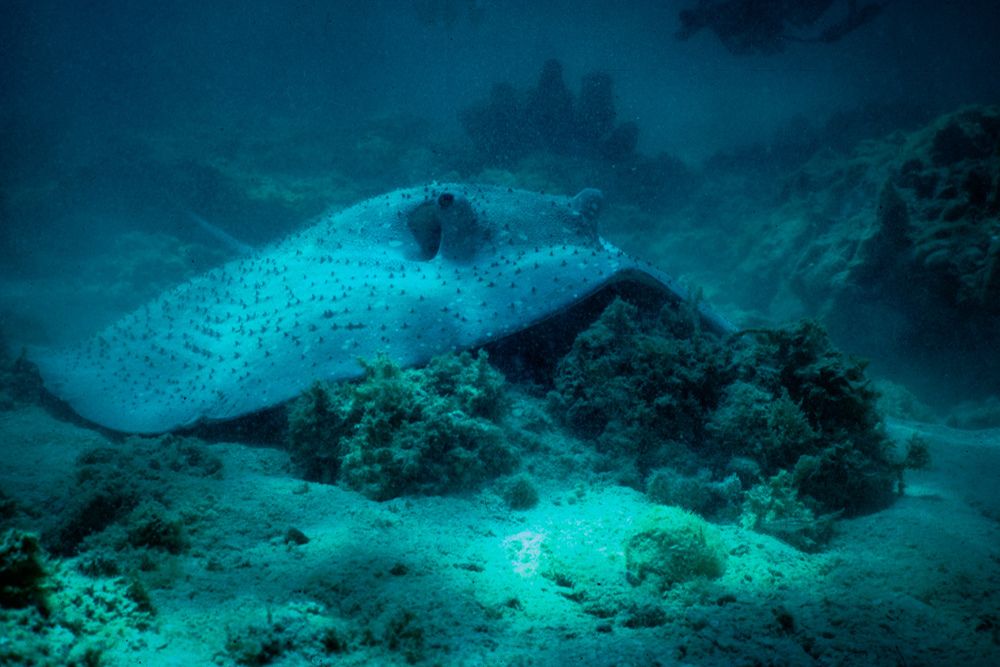
❬ BACK TO STORIES Instagram Twitter Facebook Youtube REGGIE RAY CARRYING HUMANSAT LIZARD ISLAND PETER PARKS 1985 “All wildlife filming engenders encounters with weird and wonderful animals and plants. It all requires some familiarity with the creatures, some knowledge of their habits and behaviour, some appreciation of the environment in which they live, usually a disproportionate amount of patience and always, but always, a huge dollop of luck. What one tends to forget is one other ingredient, and that is an invariable element of surprise. Early in the new year, back in 1985, I was alone on Lizard Island, awaiting the arrival of my colleague from OSF, as well as looking forward to Roger Steene joining us for a couple of weeks. Before either arrived, I was alone and enjoying some very calm, fine weather, and intent on searching a coastal stretch a mile or two from the station. Named Crystal Beach, it was storm beach, meaning one that collected interesting flotsam when southerly storms battered the island, and it was as white as snow, hence the name, “Crystal”, and it was half a mile long, dead straight, aback a coral shelf that extended up to two hundred yards seaward. To its north and south, lay similar rocky promontories that helped funnel incoming storms straight onto the beach. It tended to be little visited by the research students, because it was shallow and a bit boring. I kept a periodic watch on it, because it often collected interesting artefacts, like Nautilus shells, fishing trawl net floats and various dead fish. So, one fine day I set forth to investigate the full length of this pleasant beach. I moored at the southern end, wandered slowly down the full length, and back again. I kept back from the water because past experience had taught me that large rays frequented this beach, and a vague plan was building in my mind to see if I could approach one close enough to see it feeding. These rays were notoriously skittish, frantically flapping away across the coral platform, long before you ever came close, so somehow I needed to develop a methodology that did not freak them out. My walk, gave me the time to plan how I was going to attempt it. Accordingly, I kept well inshore, on my return walk. I slipped quietly into the boat to retrieve snorkel, fins, weight belt, camera and facemask. I eased myself into the water, floated face down, selected a depth such that I did not disturb the bottom, but shallow enough that I could touch the sandy bottom with my finger tips. Using nothing other than finger power, I began the slowest, longest glide down that half mile beach, ever performed. It was a snail’s pace. Sure enough, ahead I soon saw the cloudy disturbance that indicated that I was approaching a feeding ray. Most are bottom feeders, blowing a jet of water out, then sucking in water, sand, and burrowing sand dwellers, like shellfish, brittle stars, Sand Dollars, segmented worms etc which they filter out and swallow whole. As I got nearer, I realized the ray was facing away from me. That was lucky. Surely I could get that much closer. More finger tip gliding. Not the slightest disturbance from me. It took twenty patient minutes, but by the time my fingers were beginning to think of cramping, I was only six or seven feet from “Reggie Ray”. For nearly an hour I studied him to my heart’s content, as he dug feeding depression after feeding depression along the beach, all within forty feet of the breaking surf. It was a wonderful experience, and I returned to base feeling both pleased and privileged. The next day, I repeated the study with as satisfactory results. The day after that, Roger arrived. I told him of the experience, and we decided to see if we could do the same the third day. Rog was always game for these sort of patient encounters, and that is why he is one of the very best in his field of underwater marine close up photography. Weather was still fine, and we did exactly as I had done on the previous two days. What we had not expected was what happened next. We got so close that we were literally touching Reggie, and he seemed not to care one little bit. He became so used to us that we each tried gently to move him. Ultimately, we found that we could gently grasp him at the base of his substantial tail, and nudge him forward to a new, undisturbed patch of sand to induce further feeding activity. It was extraordinary. He seemed to have absolutely no concern with our activity. Remember, this is the type of Ray that perpetually freaked off as you approached them, by slowly wading or swimming gently towards them. Reggie and his fellow rays were all Thornback Rays, rays that do not have poison spines at the base of the tail. Rog and I have often thought back to that unique experience.” ❬ BACK TO STORIES Instagram Twitter Facebook Youtube Life on (Nonsuch) Earth Read More 3 Sailed Triangle or a Shovel Nose Ray? Read More