

Life on (Nonsuch) Earth
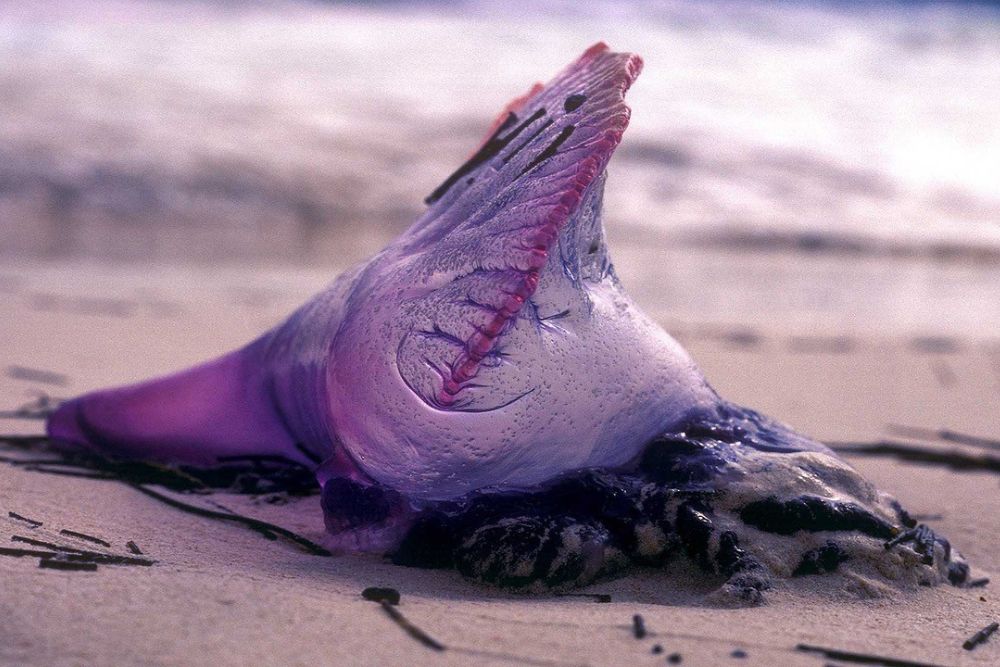
❬ BACK TO STORIES Instagram Twitter Facebook Youtube LIFE ON (NONSUCH) EARTH PETER PARKS One very grey stormy evening on Nonsuch Island, off the coast of Bermuda (on that same island as William Beebe lived while doing his epic deep-sea descent in the bathysphere, built by his engineering colleague, Otis Barton), I witnessed one of the most remarkable things I have ever seen. I strolled down to South Beach – sounds grand, but it is only about 120 feet long – and stood looking out to sea, watching the wind whip the tops off the incoming waves, while following the vain progress of numerous men-o-war, trying not to get themselves stranded on the beach. Men-o-war have no guard against this disaster other than to withdraw tentacles, deflate their floats and reduce their surface area to wind and wave. One-by-one they succumbed – slewed up the sloping sand, like inky smudges emanating from stranded bottles. One beached itself close to where I was standing, but from somewhere, came a curious slapping sound. Men-o-war do not have the ability to so much as twitch, let alone slap. I was sure that my ears were not playing tricks. Once again it happened, and this time the sound definitely came from exactly where a man-o-war lay, just as the water receded from around it, leaving it high and dry. I began then to watch men-o-war more closely, as they approached the shore. One came in, became stranded, and was accompanied by no sound at all. Another came towards me, and suddenly I knew what it was. This one had, beneath its tentacles, a very agitated Nomeid Man- o-war Fish – its startling silver and navy blue stripes unquestionably identifying it. As the Physalia swirled in on the next wave, the nomeid came with it. Now the pair were in only two inches of water and this was rapidly dwindling to two millimetres. Both creatures bottomed on the streaming wet sand. The Physalia lay limp and defeated, but not its faithful friend. The man-o-war fish fought furiously to swim, but no water! Suddenly its swimming activity translated into that mechanical rattling. It slapped the sand with its tail, making a sound like a football rattle. For fully twenty seconds it struggled. On the next but one wave it was afforded just enough depth of water, and it reluctantly allowed itself to be floated seawards, yet still faced back up the beach towards its now dying companion. What friendship, what faith, what pathos. ❬ BACK TO STORIES Instagram Twitter Facebook Youtube From Tiny Egg to Underwater Chameleon… Read More Floating, Stinging and Beautiful Bubbles… Read More
A Titan Prank and Spear Gun Mishap…
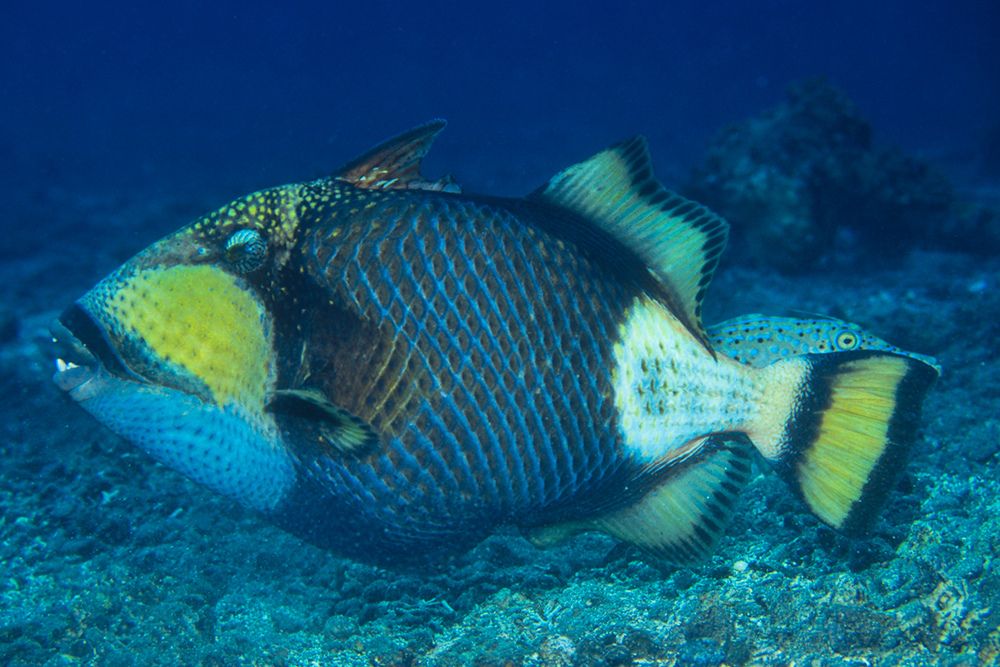
❬ BACK TO STORIES Instagram Twitter Facebook Youtube A TITAN PRANK AND SPEAR GUN MISHAP GERRY ALLEN “Jack had a wonderful sense of humour and was a good sport when he was on the receiving end of practical jokes. There are so many great stories from my travels with Jack and here are just a few examples. My good friend Roger Steene and I joined Jack for a lengthy sojourn across the Indian Ocean that was funded by the National Geographic Society in 1979. Knowing Jack’s passion to log more dives than anyone on the planet Roger and I set up a little practical joke while we were at Villingili Resort in the Maldives. The previous night we fetched a couple of scuba tanks from the dive shop and rigged them up with our gear before retiring. Then we set the alarm for 5 AM. The next morning, while it was still dark we hopped out of bed, donned the scuba tanks and took turns spraying each other with a garden hose. It looked like we had just emerged from a dive. Time to put the plan into action! We tip-toed over to Jack’s bungalow, deliberately clanked the tanks together several times and started loudly exclaiming what a great dive we had. Predictably, Jack rose to the bait. He bolted out of bed, grabbed his gear and virtually ran over to the dive shop to grab a tank. No way was he going to be out-dived, even if it meant diving at 5 in the morning. I think he finished the day with 6 or 7 dives, which was a typical effort. Absolutely nothing distracted Jack once he locked onto a potential fish specimen or photographic subject. With this knowledge Roger and I set a little trap for Jack while on the same visit to the Maldives. Female Titan Triggerfish (Balistoides viridescens) are notoriously aggressive when guarding a nest of eggs. We had both been molested by a particularly savage individual while taking underwater photographs the previous day. At one point I fended an attack by thrusting my camera towards the trigger. The fish actually seized the strobe-mounting bar with its teeth and swam off with the entire camera rig. This was one ferocious fish! It seems fiendish in retrospect, but somehow seemed entirely appropriate at the time… We hatched a plan whereby we would return to the same spot and line the triggerfish up between Jack and ourselves. Having set this up with ease we then frantically waved and shouted, indicating we had discovered something extra-exciting to photograph. Jack took the bait and swam in a bee-line towards us. Unaware of the trigger, he swam directly above its territory. Boom – the fish erupted like a heat-seeking missile. I’ve never seen anyone swim as fast as Jack with the trigger in hot pursuit. Afterwards, when we confessed it was setup from the beginning, he laughed as hard as we did! https://openoceangroup.org/wp-content/uploads/2023/09/TITAN-TRIGGER.mp4 Another humorous incident occurred in the Solomon Islands. I was doing some underwater photography while Jack was collecting specimens with a Hawaiian-sling spear. These pursuits do not always mix as I learned from the hilarious scene that unfolded. Jack was moving at top speed in mad pursuit of a small rudderfish (Kyphosus). At last he lined up a shot and drew back the firing rubber. His concentration was so intense that he did not see me, in spite of the fact I was positioned just a few meters away, directly behind the target. He launched the spear, missed the veering fish, and shot me squarely in the butt! Fortunately I was wearing a thick wet suit and was far enough away that the shot had lost most of its impetus. These “scientific” moments are sacred to me. Funny you never hear or read about them at international symposia or in scholarly journals.” ❬ BACK TO STORIES Instagram Twitter Facebook Youtube From Tiny Egg to Underwater Chameleon… Read More Floating, Stinging and Beautiful Bubbles… Read More
Whale Snot Catching Drones – SnotBot
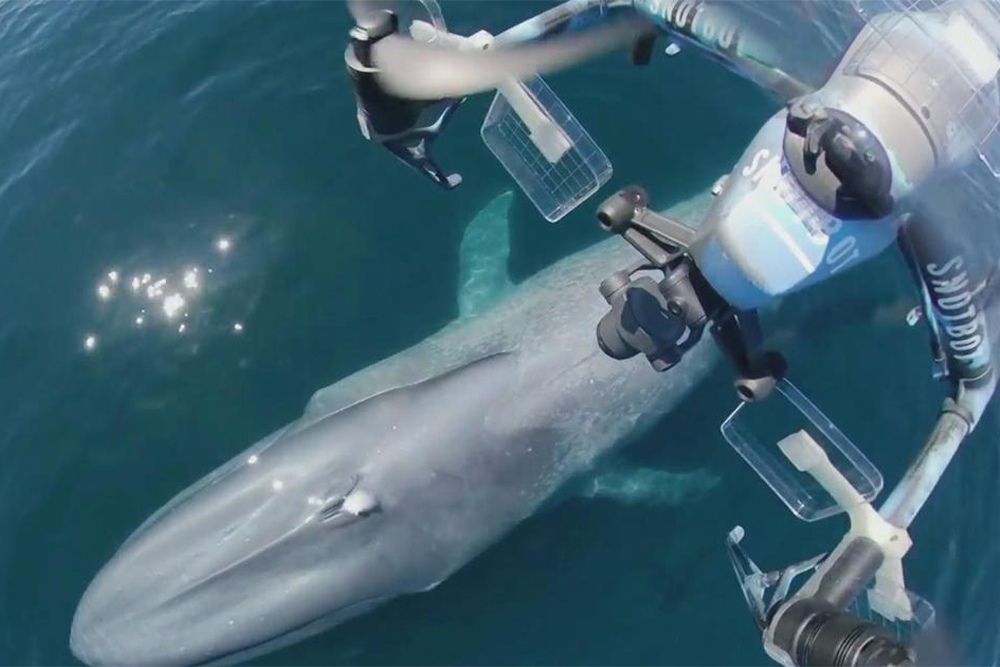
❬ BACK TO STORIES Instagram Twitter Facebook Youtube WHALE SNOT CATCHING DRONES – SNOTBOT OCEAN ALLIANCE Our very close association with Iain Kerr’s Ocean Alliance – the world’s foremost whale conservation organisation, admirably secures this field of our research and storytelling. Our two organisations, along with several others, are all part of a fraternity of ‘Share and Swap of images, stories, research and observation that guarantees that we all can preach from the same rich gospel and keep abreast of the daily influx of wonderful new insights into the goings on within our Oceans’ surface waters and the equivalent, less awe- inspiring, but still fascinating, stories from the freshwater habitats that we own and will thoroughly document. https://openoceangroup.org/wp-content/uploads/2023/09/SNOT-BOT-3.mp4 Ocean alliance are leading the way with drone research technologies. They are currently using drones to capture the ‘snot’ from whales via drones – the whale snot catching drone! The purpose of Ocean Alliance’s SnotBot program has been to explore and push the boundaries of this new research paradigm, determining what data can be collected with a drone and how best to collect it. Using SnotBot has many benefits when collecting biological samples from whales: it is non-invasive, we get a huge range of data, and it is relatively affordable. https://openoceangroup.org/wp-content/uploads/2023/09/SNOT-BOT-3-V2.mp4 SnotBot is a modified consumer drone that flies through the blow of a whale and collects exhaled “snot” on petri dishes. This blow contains a treasure trove of valuable biological information: DNA, stress and pregnancy hormones, microbiomes, and potentially many other biological compounds and indicators of the animal’s health and ecology. Best of all, the whale doesn’t even know we are there: This is a non-invasive tool that is safer for the animals and cheaper and more effective for the user. ❬ BACK TO STORIES Instagram Twitter Facebook Youtube From Tiny Egg to Underwater Chameleon… Read More Floating, Stinging and Beautiful Bubbles… Read More
Swarming Hammer Shaped Aliens…
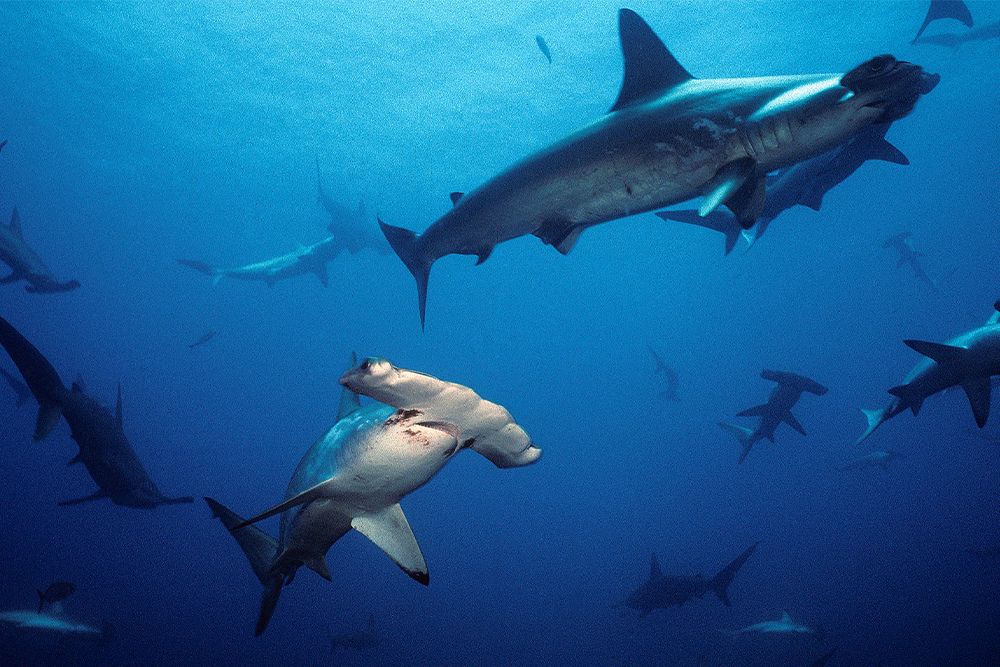
❬ BACK TO STORIES Instagram Twitter Facebook Youtube SWARMING HAMMERSHAPED ALIENS IMAGERY FROM HOWARD HALL Hammerhead sharks exhibit an aggressive hunting behaviour, primarily preying on smaller fish, octopuses, squid, and crustaceans. While they typically do not actively target humans as prey, they display strong defensive instincts and will engage in attacks if provoked. Distinguished by their wide-set eyes, hammerheads possess an extended visual range compared to many other shark species. They employ a unique adaptation by dispersing their specialized sensory organs across their broad, mallet-shaped head, allowing them to conduct thorough oceanic scans for potential food sources. Annually, substantial congregations of hammerhead sharks assemble in specific locations along the coasts of various regions worldwide. Scientists are currently investigating the reasons behind these gatherings, with one hypothesis suggesting that these occurrences coincide with seamounts, underwater mountains, where hammerhead sharks congregate for feeding, breeding, and social interaction. These sharks have been observed forming schools containing nearly 100 members during daylight hours. This schooling behaviour is believed to enhance their foraging efficiency, as further supported by their seasonal migration to cooler waters during the summer months. In contrast, during the winter, they migrate back towards the equator in pursuit of warmer oceanic environments. ❬ BACK TO STORIES Instagram Twitter Facebook Youtube Life on (Nonsuch) Earth Read More 3 Sailed Triangle or a Shovel Nose Ray? Read More